
Going Postal: Troglodyte Zombie Battle!

[This happened on May 12, Sunday 2013, between 16 and 21 UTC. Players Mike, Ian, Ralph and Demo in attendance. It being Mother’s Day, John and Toby are unable to attend. Pace is in Silverton, Oregon and all players are participating via Skype and Roll20.]

After mapping most of the complex the Green Dog Sea Caves, after fighting a strange water elemental and defeating two ghosts, including the spirit of the orc pirate king Green Dog himself, the Postal Squad counted up the treasure of the dead Pirate Chief in room 8.

A screenshot of the map where all the action happened

It was discovered that the missing money shipment the squad was sent to find was not among the treasure. There were several suggestions floated as to the whereabouts of this money.  There were:

  1. Two mysterious and locked heavy stone doors found in the prior session. One which appeared to have a great deal of water pressure behind it. These doors remained unopened.
  2. While all of the rooms of the cave complex had been mapped there was a slight possibility of a few details in any one of them that might have been overlooked.

Hinkwe and Maceo proposed disarming and exhuming the remaining spear traps buried under the beach of room 6. Care is taken and two hours labor passed as this was done. As this work proceeded, Lingerhol heard the approach of a someone or something slogging through the water filled passages outside room 6. The disarming work, which was nearly finished anyway, came to a halt and the party readied itself for combat. In the light of Bussell and Frickalind’s everburning torches, at the mouth of cave 6, a strange insect-like creature stepped out of the darkness.

A demotivational joke poster about rust monsters and how armorclad fighers fear and hate them!

The postal agents were clueless as to what this creature was but Maceo identified it as a rust monster and warned that the creature that loved to consume metals of all kinds but especial iron and steel. The party was danger of losing their weapons and armor.

Thinking quickly Hinkwe and Golath both grabbed one of the unburied traps, which had many steel fittings and linkages, and heaved it in front of the creature to offer as food.

Working on the assumption that the creature somehow smelled metal, Frikalind implored Crondussa, the Goddess of Eagles, to create a great wall of wind to blow back the scent of the party’s collection of steel weapons and armor. She then shucked her own armor and drew out her quarterstaff.

Using the spear trap as diversionary bait worked. As Frikalind removed her mail, pouches and backpack, the creature feasted. Frikalind then ran through the wind wall and struck the creature on the flank with her quarterstaff. Sated from the metal of the trap and threatened with bludgeoning from a quarterstaff, the timid creature ran off into the darkness. Frikalind considered following it but then discarded the idea.

The creature did not return, and the party returned to discussing what to do next. It is decided that it is likely the missing money shippment might be behind one of the two locked stone doors however Hinkwe, Maceo and others are wounded from the prior fight with Green Dog and everyone was depleted of magic.

It was decided to have party set camp in room 8, which was well hidden behind behind a secret door. The party rested, recovered and healed and nothing happened during the watches set save for a strange and spooky sighing heard in cave 6 on the third watch. Frikalind and Bussell, composing the third watch, sat silent and straining their ears for any other sound but there was none and morning, which was very near, came without further incident.

On daybreak, the party readied itself to march out of room 8 with the plan to investigate the stone doors again but they were caution given the report from the third watch.

Golath drew his hammer and readied himself to kick the secret door open in hopes of surprising the creatures. Maceo drew out his horn for bardic magic. Lingerhol and Hinkwe readied their bows. Frickalind, back in her armor, readied her staff for a charge. To start things off, just in case, Bussell cast a sleep spell into the center of cave 6 in hopes that it might take out whatever creatures might have moved there during the night. This action started combat and several things happened nearly at once:

  • Golath kicked the door open, charging straight out and into zombie troglodytes!
  • It was immediately clear that Bussell’s sleep spell was useless against the undead.
  • Maceo rallied the party with a song of courage.
  • Golath, at the end of his charge, nearly knocked one of the undead monsters on its rump with a mighty strike from his hammer!
  • The room was filled with a horrible stench of rotting flesh from the monsters and Golath nearly doubled over wretching.
  • This foul vapor blew over the party causing many to wretch and heave in overwhelming nausea.
  • This nausea effectively canceled the beneficial affects of Maceo’s rune singing magic.

A photo of a zombie trog miniature

The rest of the party moved towards cave 6 for a better view of the zombies. Frikalind, in particular, readied her silver eagle for an attempt at turning them.  It was her turning of the dead that was decisive in the combat for the creatures turned in horror and shame from Crondussa’s might and fled to the opposite wall of the cave.

The remainder of the party pursued with glee, striking the backs of the horrors with their favored weapons,  Bussell relying on magic missiles and Maceo dropping his horn and using his crossbow instead. The combat finished within 20 to 30 seconds and it was clear the creatures, despite cowering in abject terror, were unnaturally tough, shrugging off mortal blows and slashes.

But in the end they were rendered truly dead. And it was there that we halted the game session.
Posted in Games, Going Postal, Udra | Comments Off on Going Postal: Troglodyte Zombie Battle!

A preliminary review of Roll20

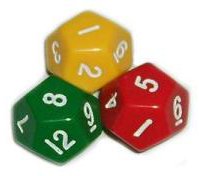
A photograph of twelve sided dice

Despite all my quixotic efforts to be the hippest thing on this planet, many things still surprise me.

As early as 2003 (and 2005, twice.) I’d been wondering if there were software tools to do bookkeeping and physics for turn-based combat in pen and paper role-playing games. It turned out that there were, and I probably could have found out about them on the Web years ago, if I only knew these tools were called “virtual tabletops.” If I knew what to look for I would have realized that the technology had long caught up with the hobby a few decades ago. With the arrival of common broadband, Internet telephony, and shared workspaces, it is now possible for tabletop roleplaying gamers to create virtual living rooms, rec rooms and basements with players all over the world. And for the last two years, thanks to the insistence of my old dear friend, Lord Odinmank, I’ve been running a new plot in my campaign Udra with players in NYC, Bahrain, and Thailand. For me this has been a revolution.

And just yesterday, one of my other old, dear friends, the Bakafish, introduced me to a virtual tabletop that turns out to be easier to use than RPTools: Roll20. Since yesterday I’ve playing around with it, loading data in preparation for my game session this coming Sunday. And I decide to give my first impressions of it.

Roll20 is browser based, built in Flash and AJAX. This means it runs in any recent browser on most platforms (Probably even most mobiles and proprietary tablets.) without installing any or much additional software. It contains the following functions:

  • A very flexible dice roller and random number generator
  • Powerful text-based chat engine that can accept macros
  • A Flash based, videoconferencing software called Tokbox.
  • A Flash based jukebox.
  • And finally, the important bit, the virtual tabletop itself.

Of these things, the videoconferencing and jukebox seem the least necessary to me, as I rarely play music during my game sessions and I already have a subscription to Skype. But I guess if Tokbox is free and works reliably for everyone, I might cancel my Skype subscription? We’ll see.

In uploading images and maps to Roll20, it gives me lots of ways to manipulate things but I wonder if it is as powerful as RPTools. I won’t know until:

  1. I actually figure out how to use RPTools
  2. Actually use Roll2o for a few sessions.

It might be that RPTools is better at really keeping track of the rules bookkeeping, which in D&D 3.5 is pretty intense. Roll20 seems to be more rules system neutral but may have many features that it sufficient for my needs. Roll20 definitely seems easier to use and is better documented than RPTools.

Roll20 is a third party service and seems to have no easy way for me to export all my data, just in case the service crashes or ceases to exist. RPTools is open, decentralized and peer-based, which is better I think. For the same reason I dislike Facebook, I may come to dislike Roll20. Peer-to-peer is better than centralized, third party services, even if a little harder to use.

But I’ll post a later, more detailed review after a few sessions use of Roll20.


Posted in Games, The Internet, Udra | Comments Off on A preliminary review of Roll20

DNA logic gates, Merkle's rod logic gates

A computer rendering of DNA transcription.So, from various sources, today I learned about a team of molecular biologists at Stanford University who’ve constructed logic gates out of the DNA transcription machinery. There is a video summary with some animations as well. While reading about all these things, I was reminded very strongly of Ralph Merkle’s nanomechanical rod logic gates, which I read about many years ago in Engines of Creation. If they can make this work cheaply, easily and reliably, there may be something to this mechanosynthesis idea of Feynman’s after all, eh?

Posted in Science and Engineering, Science Fiction, The Future | Comments Off on DNA logic gates, Merkle's rod logic gates

Why don't I embed video on my site?

Well, this gets into my endless arguments about W3C standards, interoperability and freedom from any proprietary software. But basically I hate Adobe’s Flash utility. Yes, it’s widely supported but, it’s proprietary and, I’d rather not have the Internet held to the whims of any one company.

So if I am going to have any interactive bits here at all, if I’m going to have any multimedia at all, they are going to be implemented with SVG, HTML 5 or similar open, non-proprietary methods as recommended by the W3C. Either that or I’ll just link to another page with the audio, video or interactive gadget in question and let you sort it out for yourselves.

In this post-Twitter, post-Facebook, world, most people don’t care about these infrastructural issues and, they shouldn’t need to. I don’t expect any comments on this but, I’m been a strong vocal supporter of Web standards since 1998 and, being totally vindicated in my stance on CSS, this is my new line in the sand to draw. I expect I’ll be vindicated here too.

Posted in The Internet, Webmastering | Comments Off on Why don't I embed video on my site?

Words that I've coined.

Okay, to preface, I’ve searched the Web for these words and I’ve found that in all cases, it was only me that was using them, or if they were used by someone else it wasn’t in any coherent way beyond spamming search engine results. So this is my notice to the anglophone world. I coined these words over the last 13 years and, for posterity, am defining them here.

However I want to categorically state, I do not own these words, nor make any claim to them. They are completely public domain and I expect no credit whatsoever for coining them. Not that the world gives a hobo’s cuss what I think or do.

Synthozoic
sin?TH??z?ik adj (1999) Of, relating to, or denoting artificial life, synthetic biology or engineered organisms of any kind. Artificial replicators like computer viruses and network worms are synthozoic. The Synthozoic Era would be a geological era on the Earth when artificial life emerges and predominates. After the Skynet destroys humanity and rules the Earth, that is the launch of the Synthozoic Era.
Cosmonym
käz?m??nim n (2007) The name of any specific universe in the multiverse. The universe where the evil, Van Dyke wearing Mr. Spock lives and serves the Terran Empire is called the “Mirror Universe;” that’s a cosmonym.
Cosmonymics
käz?m??nimiks n (2007) The practice of making simple naming schemes for universes within the multiverse. A system of naming universes.

Just for posterity, y’all. You’re welcome.

Posted in Personal, Science Fiction | Comments Off on Words that I've coined.

Premise for a science fiction story: Lenin revived from cryonic suspension

A screenshot of Robot Lenin outside the Steel Canyon University in Paragon City

This is an idea I had for character in the game of City of Heroes, a game now sadly deceased. (These days I play Champions Online, based, at least partially on the venerable and wonderful Hero System table-top rules set. CO is a worthy enough effort but, still currently a pale shadow of Paragon City.) Anyway, the idea was so cool I saved it here to use, maybe one day, for a science fiction story. It’s all based around some obscure facts I found on Wikipedia one day about six or so years ago.

Part of this is reprinted at the Virtueverse wiki.

Biography

Robot Lenin’s origin is rather complicated–but maybe not by comic book standards!

Robot Lenin is not from the universe of Paragon City (Portal Catalog Cosmonym Alpha Alpha 0-0) but from a universe (Portal Catalog Cosmonym Xi Xi 23-72) with a similar historical background but radically different physics. For example, in Robot Lenin’s universe, magic and psychic forces simply don’t exist and, he has had some trouble getting used to their existence in Paragon City. Nor is Robot Lenin from our real universe (Portal Catalog Cosmonym Pending) either. The history of his Earth departs from ours in 1924, the year of Lenin’s death. His arrival on the Earth of Paragon City is quite by accident. Portal Corporation scientists tuned into his universe in their attempts to seal off alternative routes from the Rikti Universe. Just before the moment of his discovery and transference to the Portal Corporation labs in Paragon, Robot Lenin was aboard a Russian space colony writing a lengthy treatise on the subject of rights for artificial organisms.

How is it possible for a man, who died in 1924 from his third and final stroke, to be found on a space station orbiting Venus in 2085? Let us start with this obscure historical fact from early Soviet history:

In our universe and the universe of Paragon, nothing came of this.

But imagine on the Earth of Universe Xi Xi 23-72 that this project, buried in deepest secrecy and bureaucratic obscurity, was actually put through! What if Lenin’s frozen corpse survived Stalin, World War II, the Cold War, the Cuban Missile Crisis and the Fall of the Berlin Wall. Suppose that the vacuum bottle containing Lenin’s cryonically suspended brain passed out of the hands of a corrupt former KGB officer to a minor party of eccentric Russian techno-anarchists? Imagine they kept this brain cold until the rise of nanotechnology and the precipice of a Vingian Singularity. Now, imagine an android of Lenin reborn in a Russian space colony, armed with Gordeyev 74 piston boots, a Kalashnikov 217 rifle and a few new subversive tracts he’s written, fighting to free all sapient artificial life from the hands of its organic oppressors!

This is a quotation from Robot Lenin’s journal soon after his arrival in Paragon:

My doctors, being good Russian cosmonauts, were quite prideful in telling me that I was the first. I’m the first cryonically suspended patient, a full 43 years before Dr. James Buford was suspended in 1967. I was not the first be revived of course. It was 1924 and the understanding of cryoprotectants was still quite primitive. Krasin and Bogdanov considered a variety of sugars, settling on a mixture of glucose and glycerin. As such the freezing damage to my brain was too extensive for me to join that first wave of revivals in the latter 21st Century. Several reconstructive models had to be tested in software before the cell repair machines were sent into my skull to reverse what damage they could.

Even still, I’m not really sure I deserve the name Ulyanov. After I awoke there were noticeable gaps in my memory of those days. In my former life as a student and later as a lawyer and politician, I practiced extensively to improve my memory so, it was very disturbing to me to find these gaps. My doctors tell me that is sadly unavoidable, a consequence of the primitive freezing process my corpse underwent.

Since then, as a way of filling in the gaps, I’ve looked at photographs of my family, home, relatives and comrades in the struggle. I’ve been re-reading my works, notes and diaries that Soviet historians thought to preserve. This was somewhat successful but some things will remain forever lost to me. I think that many would agree that memory and the reaction to experience are what make a major portion of personality. A child may be born with certain tendencies and favors but change a man’s memory and you change who he is fundamentally. I think the real Lenin died in 1924. I am only a reasonably good copy.

However this leaves me with the situation of who I am and how I define myself in this new life.

I’ve read the history of the Union of the Soviets, from my death until it dissolved in 1991. Oh! If I could have been there in 1945 at our victory over the fascists! If I could have been there in 1957 when we stunned the world with our artificial moon! We were powerful and justly viewed as an alternative to capitalism.

But if I was there when Stalin had Trotsky assassinated, if I was there at the purges of the Old Bolsheviks of the 1930s, if I was there at the founding of the NKVD–that was my fault. I decreed the creation of the Cheka. It was civil war but, I signed the orders for the campaign of terror against White Faction sympathizers. In the face of all the repression and death that followed, can I be allowed to change my mind? How do I say that I’m sorry?

I’m not entirely sorry. People forget what the dawn of the Twentieth Century was like. In most industrial countries unions were still illegal, women did not have franchise, ethnic minorities were barely considered human, let alone citizens, most of the world was held in the grip of exploitative, violent empires. Were we entirely wrong? Was I entirely wrong? Was there some justification for what we did in those days of October? We really believed we were trying to make a better world. The road to hell is paved with good intentions.

But now, here I am in a world where all of that seems like ancient history and, I’m not entirely sure I am that Vladimir. Further, I’m now in a world where nearly anything is possible so, to paraphrase the man I’m modeled after: What is to be done?

Robot Lenin looks just as Vladimir Lenin looked in 1917. His android body allows him to appear as a younger man but he forgoes this because he knows the 1917 suit and cap are iconic and easily recognized. He also doesn’t bother to adopt body armor or an outfit suited for greater wear and tear because the smart fabric of his three piece suit is self-repairing and his body is far more durable than his human one ever was. Often the only changes he makes in his appearance is when he carries his AK-217 or when he pulls on his Gordeyev 74 boots for running at high speeds. When indoors, in formal settings, he’ll remove his cap, revealing that he is still bald.

Abilities and Weaknesses

Robot Lenin does not need sleep or food being entirely micromechanical and powered by advanced, solid-state capacitors. His brain is noticeably smaller and more efficient than a human brain and in located in an armored container composed of alloyed diamond in his torso. However due to heat dissipation, size and space for backups, his mind still operates at human speeds. Robot Lenin’s Earth of origin is more technically advanced than most of Paragon Earth’s science. On the other hand, R. Lenin has almost no engineering or technical knowledge and thus can’t repair his more advanced organs should they be damaged.

The strange magic-infused physics of Paragon Earth also plays havoc with some of his micro- and nanomechanical systems. Some of these he has had to replace with less efficient Paragon analogs. Luckily, he is no more or no less susceptible to magic than any other creature of this universe. But his lack of knowledge sometimes drives him to make unsafe assumptions and decisions. For example, he still occasionally forgets that psychically endowed minds can scry on him from remote locations without instrumentality.

His Personality

His personality is outgoing, charismatic and witty but friends and associates sometime complain that his wit can often be cruel. He is a fiendishly clever disputant and can quickly tear down any opposing position that is not built on rock solid logic. He’s not one to suffer fools and, with many years of experience as a politician, he’s used to having his will obeyed. However, the profound transformation he underwent after his death, the cultural shock of modern technology and his learning of Russian history after 1924 has humbled him. He hasn’t admitted it to anyone but he now feels directly responsible for the deaths and human rights abuses of the Soviet Union. To his dismay, these second thoughts have made him less decisive than he used to be. But, he really hasn’t moved very far at all to the right. He’s still quite skeptical of capitalism believing that automation can free all workers from the dull drudgery of boring, vocational labor. He now vehemently advocates that all sapient creatures, emergent or synthetic, should be given full and equal rights. If necessary, by violent revolution or armed force.

Additionally, as the artificial duplicate of a Vladimir Lenin from another universe, he has taken great pains to distance himself as having anything to do with the real Lenin of Paragon’s Earth, who died and was embalmed in 1924. So far, he has not ventured back to Russia and has loudly and publicly refused all invitations to do so. This he feels is necessary for fear of introducing political upheaval in that country. In the universe of his origin he had exiled himself to space to avoid similar problems with his Russia. His secret motive for doing this was also to plot revolution for the oppressed robots of his world’s present of 2085.

Actually there is a great deal about his Earth that he has yet to explain.

Footnotes:

  • Universe Alpha Alpha 0-0 as designated by the Portal Corporation’s Catalog of Cosmonymics.
  • Designated Xi Xi 23-72 by the Portal Catalog.
  • Luckily for us–in my opinion–Portal Corporation has not yet discovered our universe, let alone our Earth, so it has no cosmonym.
  • “Aperture Science! We do what we must because we can!”
  • By the way, cosmonymics is a word I coined (Only one near-miss in the search engines.) to refer to naming schemes for universes in a multiversal system. This becomes deeply problematic when realizes that there might be infinite numbers of universes and infinite, exact duplication of universes and histories. Without modern set theory it’s enough to make a mathematician weep.
Posted in Games, The Future | Comments Off on Premise for a science fiction story: Lenin revived from cryonic suspension

This could be the decade of tiny robots

A photo of Chris Conte's 'Red Widow' sculpture

I’ve just noticed something that has been slowly happening over the last ten or twenty years. New technology and manufacturing techniques will soon make it possible to make millions of tiny machines, perhaps even microscopic robots, cheaply.

For example, it has now become possible to make supercapacitors out of layers of graphene (As also described in Nature Magazine.) very cheaply. These graphene supercapacitors (Vimeo has video on how UCLA’s Ric Kaner and his team made graphene supercapacitors.) can be very small while having large electrical storage capacity and quick recharge times. Supercapacitors, by themselves, are revolutionary and will make major changes to electric cars, solar and wind energy production and usage, as well as making consumer electronics cheaper and more convenient to use. But Professor Kaner and his team of researchers are mostly focused on what this might do microelectronics.

Which brings me to the next point. Over the last 5 or so years, another team of researchers at Harvard have perfected techniques for the manufacture and assembly of insect sized robots. The Harvard Microbotics Lab have made a tiny electromechanical bee by laser etching laminated materials and a popping and folding assembly process, as described in this video.

So what does this all mean? Well, basically, little tiny robots with very long battery life. Considering all this sudden progress, I think the coming decade is going to end with these tiny robots being used by the military, the government and by business to all kinds of things–some of which might be very disturbing, like spying on people completely unobtrusively. Buildings might deploy solar powered artificial barnacles that scrape off graffiti or repair tears in carpets. Artificial bees might fertilize food crops for us. Artificial ladybugs might grind pests into mulch. Robot ants might disinter and disarm mines in war zones.

Or, and this is harder for me to guess at, millions of robot termites might one day work in factories using scanning probe microscopy to quickly and cheaply make smaller machines still, the nanomachines Drexler promised back in the 1980s.

Posted in Science and Engineering, The Future | Comments Off on This could be the decade of tiny robots

The Lingering Reasonableness of Alcubierre's Metric

A simplified image of what Alcubierre's space warp looks like.As an aging ex-physics major, knowing just barely enough to glimpse at possible answers but not enough to really know if I’m right–a little knowledge is a dangerous thing because it makes you presumptive that you’ve got all the facts when you don’t, I remember the first time I read about Alcubierre’s space warp. It was in American Scientist magazine at the Crossroads Shopping Mall in 1994, just before the Internet was opened to the public. I even used the idea in a collaborative fiction role-playing game on Compuserve.

I state that to give you some context about how long I’ve known about the idea and how badly I currently understand it.

Since that time, other physicists have made calculations and have done research that indicate Alcubierre’s warp has a lot of problems, so I’ve remained very skeptical of it. But recently I read on Slashdot and IO9 that NASA’s Harold White and others have worked out some calculations that indicate that Alcubierre’s faster than light idea might be easier than we thought.

Let me give some more boring information about how insane I am. When I was a kid in high school back in the late 1970s, I decided I wanted to be a physicist. I decided this for a lot reasons but chief among these was the secret wish to prove that faster than light travel and communications was possible. Mostly because I read a lot of science fiction but also because I knew how huge and old the universe was and how frustrated I was that we’d never have any reasonable means to look at any of it close up. Out of all the fantasy of science fiction, faster than light travel was the one thing I desired the most. The insanity comes from having this desire yet also knowing enough science to know how utterly impossible it is. Einstein, for very, very good reasons, conclusively proved that for things to make sense there must be a cosmic speed limit.

Since that time, Robert Forward wrote some speculative articles in Analog and Omni magazine about how wonderful negative mass would be if it existed, Kip Thorne did some calculations to make a stable wormhole for Carl Sagan’s science fiction book, Contact and then Alcubierre came out with his calculations. And there is a lot experimental evidence for negative space-time metrics, the Casimir Effect, Alan Guth’s Inflation Era and, just recently, the discovery of the cosmic acceleration and dark energy. That and the embarrassing, eighty year old problem of reconciling General Relativity with Quantum Mechanics.

The idea just wouldn’t go away. And now Harold White thinks that FTL motors are actually doable, that it’s no longer a scientific problem, it’s an engineering one. Part of me is utterly thrilled like a little kid, the other part thinks it’s utter bullshit. I’m crazy.

Posted in Personal, Science and Engineering, The Future | Comments Off on The Lingering Reasonableness of Alcubierre's Metric

Jack Kirby in Motion

An animated image of Jack Kirby's art,   Stan Lee's dialog and Sinnott's colors. So this is really a miscellaneous post about several things and just an excuse to keep my site from going stale. The animated image is just there so you won’t think this is a complete waste of your time.

You have to click the image in order to see the animation.

This wonderous animation was made by Kerry Callen.


Posted in Miscellaneous | Comments Off on Jack Kirby in Motion

It's hard to maintain patience with my fellow apes

I read some depressing news today about lingering sexism in nerd subculture. And it’s not that I was shocked by it, I mean, I knew it was still there. I only had to look at comic book covers or read news about booth bunnies at video game conventions to know that it was still there. But it was depressing for a few reasons:

  1. It’s the Twenty-first Century, decades past the Stonewall Riots, past Rosie the Riveter, past the assassination of Malcolm X and all the rest of it and shit like this is still happening. I’m reminded of how I felt during the riots in LA back 1992.
  2. Richard Dawkins was a sexist jerk and now I worry that people, wags and trolls on the Internet mostly, will use that to paint all atheists or skeptics in the same stripe.

Anyway, it’s stuff like this that drives my misanthropy. I’d have us all replaced by Asimovian robots, or something like that, creatures designed to be morally better. But then again, at the age of 49, I’ll probably never live to see something like that happen. I want to be post-human but I probably won’t see it.

Besides, this news has to get out. How else are we going to learn to be better? I just have to accept that this repetitive, two steps forward, one step back, never-seem-to-learn, shit is really about as fast as we silly apes can go.

So it goes. Somehow we’ll sort it out.

Posted in Personal | Comments Off on It's hard to maintain patience with my fellow apes